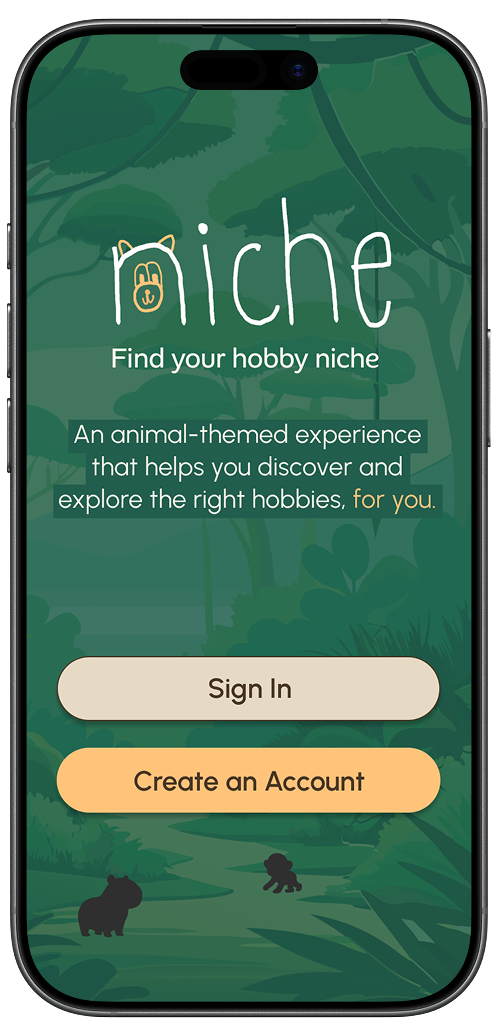
Designing a Mobile App Prototype
that helps people discover and sustain the right hobbies, for them.
Project Type: Conceptual Prototype
Dates: April 1 - June 1, 2026
Roles: I was the solo UX designer handling ideation, user research, competitive analysis, rapid prototyping (Figma), UI/design system creation, usability testing, and iterations
As part of my Masters in Information Design and Strategy (UX Specialization) at Northwestern University, I built a gamified mobile app experience that fills a need for young adults like no other app was doing.
Overview
Niche is a mobile app concept that explores how research-led intuitive, desirable, and accessible product design can help people lead more joyful lives outside of work.
One in four Americans now report burnout in young adulthood (SWNS, 2025). Luckily, there is a research-backed solution for helping to improve a young adult’s well-being – adopting a hobby. Leaning into a hobby’s mental health benefits, the initial goal was to create a mobile app prototype within a nine-week time frame that strengthens young adults’ relationship with hobbies.
Through exploratory user research, rapid prototyping, and usability testing, I ended with niche: A high-fidelity, gamified prototype solution that personalizes hobby discovery and guides young adults toward meaningful, sustainable participation.
→ The Overarching Problem
Young Adults Are Stressed
Twice as many young adults report anxiety when compared to teens (Harvard News Editor, 2023), and young adults’ stress levels nearly double those of people ages 65+ (Medaris, 2023). The most cited reason for mental health issues was “a lack of meaning, purpose, and direction” at 58% (Harvard News Editor, 2023). Stress related to finances, social isolation, and careers adds an additional weight on to today’s young adults (Newport Institute, n.d.) (Amen Clinics, 2025). Arguably the most staggering finding, one in four Americans now report burnout in young adulthood (SWNS, 2025).
→ What is Known
Hobbies Can Help
The enjoyment that comes from a pursued hobby has been found to have positive effects on mental health and reduce cortisol levels that in turn decreases stress (S.R., 2024). Hobbies can also lessen the mental burden that comes from overwhelming or demanding jobs (Borges, 2024), offer an outlet for self expression and fulfillment (Iyer, 2024), and prevent burnout (Varma, 2025).
Hobbies can clearly be a strong outlet for helping young adults combat their mental health and well-being challenges, but I needed to know more about why and how young adults interact with hobbies, and if there are barriers that get in the way of hobby adoption.
→
So, I recruited and conducted 7, one-on-one exploratory interviews to understand behaviors, goals/motivations, pain points, and attitudes towards hobbies.
What User Research Revealed
The biggest pain points to hobby discovery and adoption are:
Lack of hobby knowledge
Location limitations (weather and resources)
High barrier to entry
Skill concern
Hobby mismatch (hobby isn’t the right fit for lifestyle)
Hobbies are inherently a social experience, even for solo hobbies.
Many hobbies are currently found by chance or through social influence.
Young adults see their hobbies as a reflection of themselves - very closely tied to self identity.
Some hobbies have high “ROI” curves.
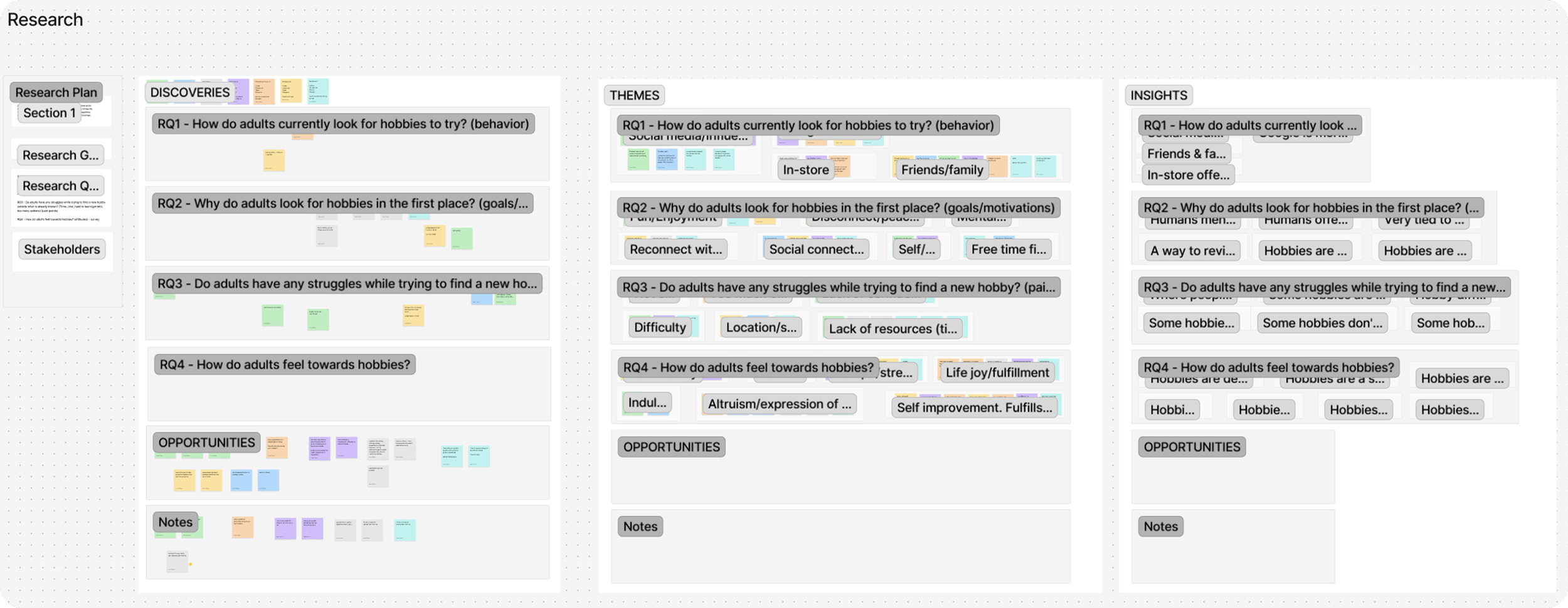
Affinity map interview results in FigJam
The Real Problem and Target User
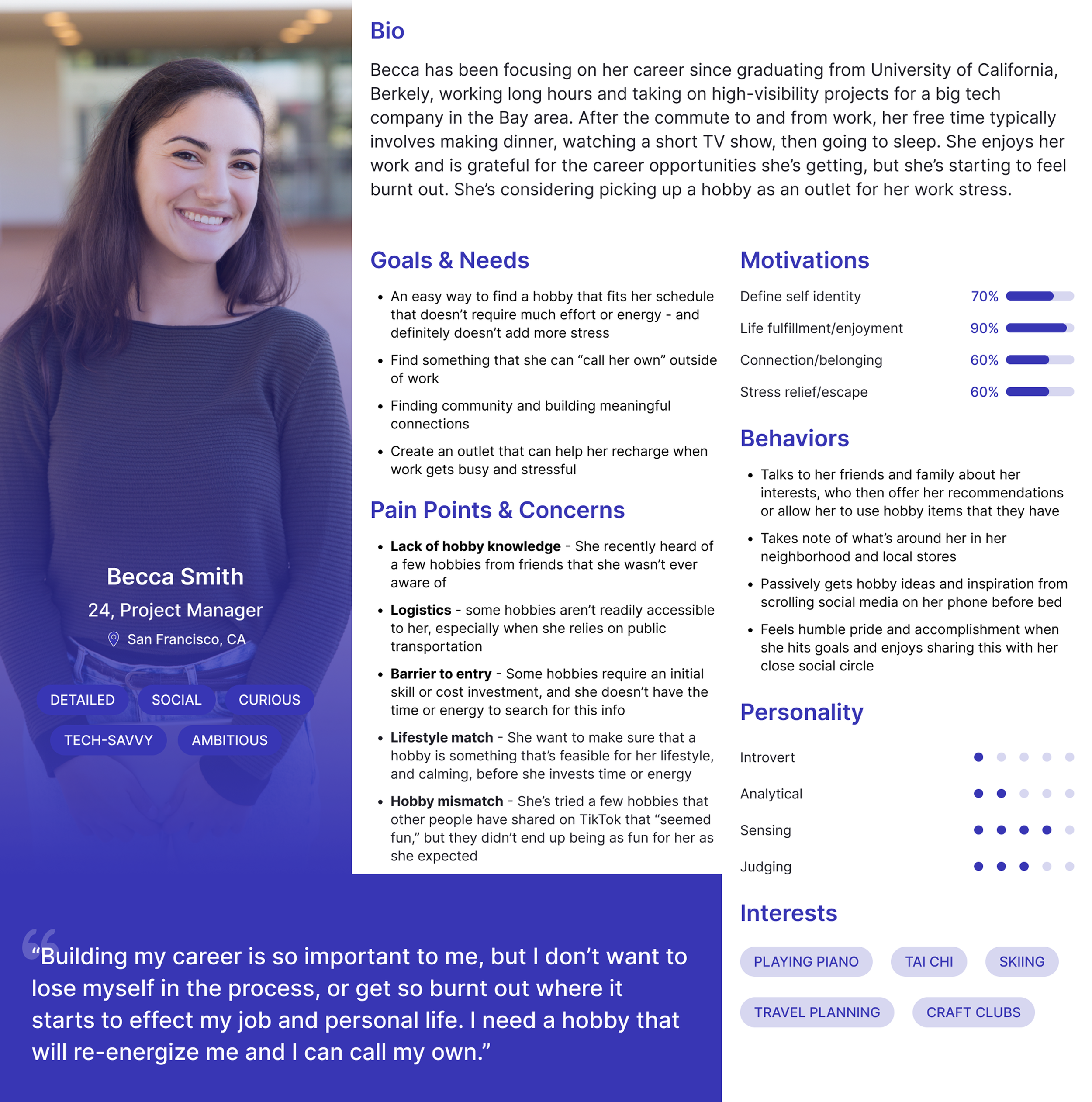
Hobby Exploring Young Adults (HEYAs) see hobbies as a reflection of themselves, but they don’t have a single resource that aids in realistic and personalized hobby discovery or exploration.
→
Meet Becca!